ServicesSpace Maintainers
Space Maintainers in Southborough
When a baby molar comes out years early, nearby teeth start to drift into the gap. A space maintainer holds that room open until the permanent tooth arrives. We fit it gently, check it at regular visits and remove it when its job is done.
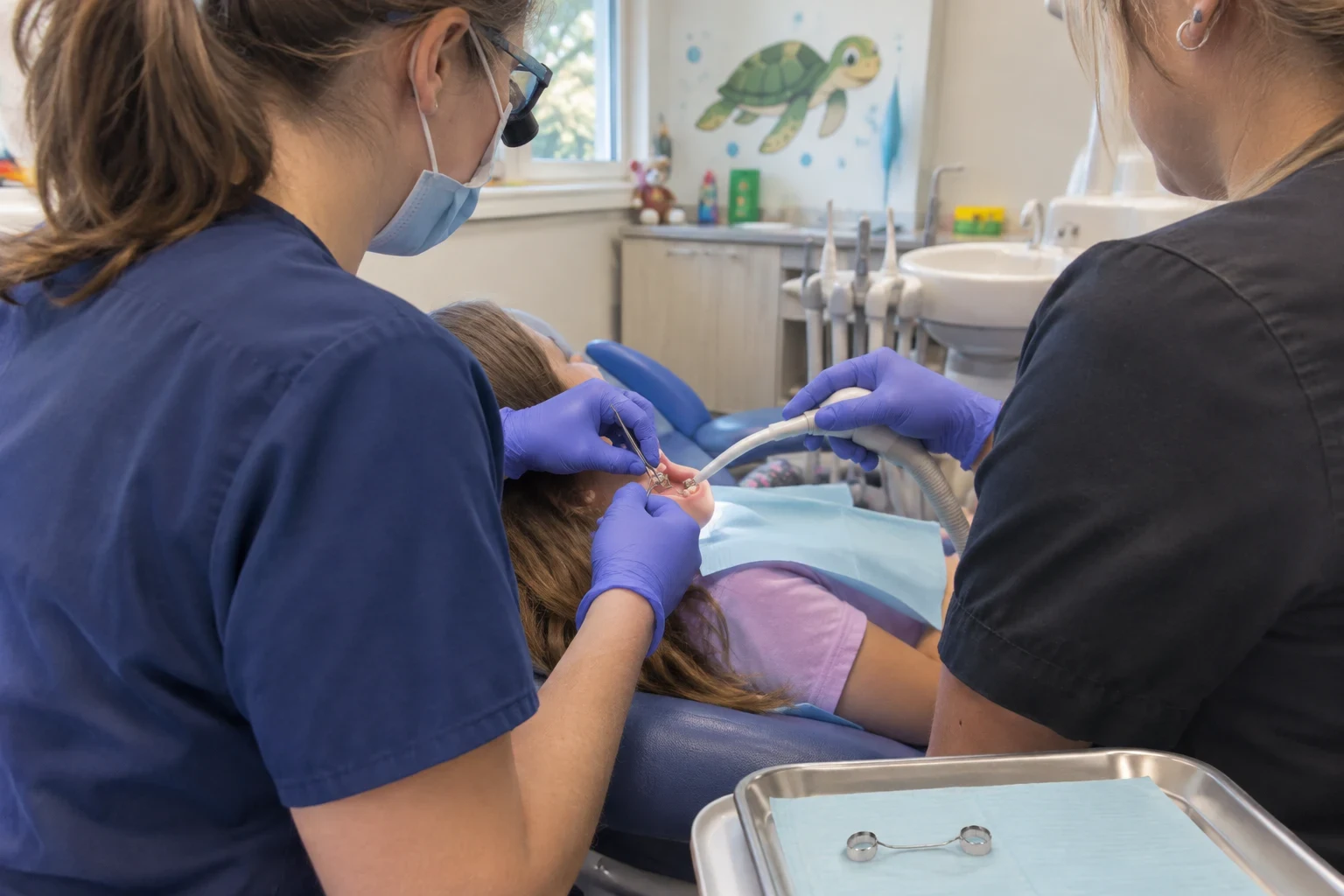
A small appliance that protects the years ahead
A space maintainer is a small appliance, usually stainless steel, that keeps open the gap left when a baby tooth is lost before its time. Baby molars hold space for premolars that often don't arrive until age 10 to 12. When a molar is lost early to decay, infection or an extraction, the teeth beside it tend to tip and slide into the opening, sometimes within a few months.
We weigh it as a question of cost over time. A simple appliance now is a modest step next to orthodontic work to reopen space later, or an adult tooth that comes in blocked, crowded or out of line. Not every gap needs one, though. If the permanent tooth is close to coming through, or the lost tooth is a front baby tooth, we may simply watch it, and we will tell you that plainly.
What the work includes
Band-and-loop maintainer
A thin stainless steel band is cemented around the tooth next to the gap, with a wire loop reaching across to the far side. It is the most common choice for a single missing back baby tooth. It is small, sits low and most kids stop noticing it within a few days.
Holding arch for both sides
When back teeth are missing on both sides of the lower jaw, a wire runs along the inside of the front teeth and connects bands on the left and right. One appliance holds both spaces, which means fewer parts to look after.
Distal shoe for an early second molar loss
If the second baby molar is lost before the first adult molar has erupted, a small guide extends just under the gum to steer that adult molar into place. We explain this one carefully, because it needs closer follow-up.
X-rays and a clear plan
Before recommending anything, we look at where the permanent tooth sits and how far along it is. That tells us whether a maintainer is worth it and roughly how long your child will wear it.
Checks and removal
We look at the appliance at each cleaning, re-cement a band if it loosens and take it out once the adult tooth starts to come through. Removal takes a few minutes and needs no numbing.
Signs your child may need a space maintainer
A baby molar lost to decay
Back baby teeth are meant to stay until the preteen years. If one is lost much earlier, the space is at risk.
A recent or planned extraction
If a tooth has to come out because of infection or injury, we often plan the maintainer at the same time. Our Extractions page explains that visit.
The gap is getting smaller
Parents sometimes notice the opening looks narrower than it did a few months ago, or that a neighboring tooth is leaning in. That drift is the reason to act sooner rather than later.
The adult tooth is still years away
An x-ray showing the permanent tooth deep in the jaw means the gap has a long time to close. That is usually when a maintainer pays for itself.
An existing appliance feels loose or bent
A band that lifts, a wire that pokes or a loop bent from chewing should be looked at soon. A quick fix keeps the space and avoids a full replacement.
How it goes, visit by visit
- 1
Exam and x-rays
We check the gap, the bite and the tooth waiting underneath. You leave with a plain answer on whether a maintainer makes sense and which type.
- 2
Fitting and impression
We size a band to the anchor tooth and take an impression so the appliance can be made to fit your child's mouth precisely. Nothing is drilled, and most kids find this part easy.
- 3
Placement
At the next visit we cement the appliance, check that it sits flat against the gum and test the bite. We go over brushing around the band and which foods to skip before you head out.
- 4
Checks until the adult tooth arrives
At each regular visit we confirm the appliance is secure and track the permanent tooth. When it begins to erupt, we remove the maintainer so nothing stands in its way.
What shapes the fee
The fee comes down to which appliance your child needs and how long it will hold the space. Before anything is made, we walk you through the options and what each one involves. That way you can set today's cost against the orthodontic work it may help your child avoid later. Payment can be made with MasterCard, Visa or Discover, we work with most insurance plans, and the CareCredit Patient Payment Plan is available too.
- Which appliance fits the gap
- A single band and loop is the simplest to make. A holding arch or a distal shoe has more parts and takes more careful fitting, so it involves more work.
- How many spaces need holding
- When back teeth are missing on both sides, one arch can often do the job of two separate appliances. That usually means fewer parts to check and replace over the years.
- How soon it goes in
- A maintainer placed shortly after the tooth is lost keeps the plan straightforward. Once neighboring teeth have already drifted, the approach may have to change.
- Day-to-day care
- A well-looked-after appliance can stay put until the adult tooth arrives. Sticky sweets and chewing on the wire are the usual culprits when a band lifts and needs re-cementing or a new appliance.
Questions parents ask about space maintainers
Something not covered here? (508) 440-4007
Will my child feel any pain getting one?
Most kids don't need a shot, and there is typically no drilling. Your child may notice a firm push as the band settles onto the tooth. The mouth can feel a little unfamiliar for a day or two, and most children stop thinking about it soon after.
How long will my child wear it?
It stays in until the permanent tooth starts to break through, which might be a few months or a couple of years. The x-ray gives us a reasonable estimate. We track progress at each regular visit and adjust the plan if things move faster or slower.
Is it ever fine to wait and watch?
Yes, in some cases. If the adult tooth is nearly ready to come in, an appliance may not be worth it, and we will tell you so. When that tooth is still years away, waiting usually lets the gap close, which is harder to correct later.
Are there foods my child should avoid?
Everyday meals are fine. Gum, caramels, taffy and other very chewy candy can tug the band loose, so those are best left out. Have your child brush gently around the band and wire morning and night.
What if the appliance loosens or falls out?
Keep the appliance if it comes out, and give us a call to schedule a visit. A loose band can often be cleaned and cemented back in place instead of being replaced. Until then, ask your child not to push or pick at it.
Keep the space for your child's adult teeth
If your child has lost a back baby tooth early, a short exam tells us whether the gap needs holding. We see families from Southborough and nearby towns such as Westborough and Framingham.